The Keeper of the Unspoken Covenant
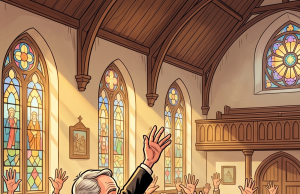
The clinical atmosphere of the intensive care unit usually hummed with a detached, rhythmic efficiency, but at that particular moment, the air in Room 412 seemed to thicken and congeal into a heavy, suffocating silence. The heart monitors continued their persistent, green-lined chirping, and the overhead fluorescent lights cast a sterile, flickering glow that drained the color from everything it touched, yet the human activity in the room had come to a staggering halt. Only seconds before, the elderly man in the bed had erupted into a frantic, jagged shriek the moment the attending nurse reached out to adjust the blood pressure cuff on his thin, translucent arm.
“Get away from me! Don’t you lay a hand on me!” Arthur Vance had roared, his voice cracking with a primal, terrified energy as his eyes darted around the room, seeing only monsters in the shadows of the medical equipment. He was a man drowning in the rising tide of his own mind, a man who had woken up trapped in a skeletal frame he no longer recognized, surrounded by white-coated strangers whose kindness felt like a threat. He was clawing at the air, his breath coming in short, hitching gasps that threatened to spiral into a full cardiac event, until the large shape at the foot of his bed began to stir.
It moved with a slow, deliberate dignity that commanded the attention of everyone present, a creature of silvered fur and ancient, knowing eyes. The dog was a massive Golden Retriever mix named Buster, whose muzzle was so heavily dusted with white that he looked as though he had been wandering through a permanent snowstorm. His back legs trembled with the unmistakable stiffness of advanced years, yet he navigated the maze of plastic tubing and metal rails with a surgical precision, eventually pressing his broad, warm head firmly against Arthur’s heaving chest.
The transformation was so instantaneous that the doctor standing by the door felt a lump form in his throat. The hands that had been reaching out to strike or defend suddenly went limp, the fingers uncurling as they instinctively found their way into the thick, familiar coat of the dog. The terror that had etched deep, jagged lines into Arthur’s face smoothed away into a look of profound, heartbreaking relief.
“Oh… there you are, old friend,” Arthur whispered, his voice dropping from a scream to a soft, melodic croon. “I thought I’d lost the trail for a second.”
The Rescuer and the Rescued
The medical chart hanging at the foot of the bed told a story of biological erosion, a clinical summary of a life being erased by the relentless progression of advanced dementia. It spoke of a seventy-eight-year-old former high school history teacher, a widower who had spent forty years explaining the past to others, only to find himself unable to hold onto his own present. Just an hour earlier, the neurologist had taken Arthur’s daughter, Sarah, into the hallway to gently explain that her father had likely crossed a threshold from which there was no return, a place where names, faces, and even the concept of family had become unrecognizable.
And yet, here was a man who couldn’t remember the year or the city he was in, speaking to a dog with a clarity that defied every diagnostic scan in the building. Buster had entered Arthur’s life nearly twelve years ago, long before the first shadows of forgetfulness had begun to creep across the edges of Arthur’s mind. They had found each other on a bitter, rain-slicked night in late November, back when Buster was just a shivering, nameless stray huddled in a cardboard box behind a local diner. Arthur had tucked the dog inside his heavy wool overcoat and carried him home, murmuring a promise that had become the foundation of their shared existence.
“You’re going to be just fine, buddy. As long as I’m breathing, you’ve got a home,” Arthur had said that night, and for over a decade, that promise had been kept with a religious devotion.
When Arthur’s wife had passed away four years ago, it was Buster who had sensed the crushing weight of the silence in the house, choosing to sleep on the empty side of the bed for six months until Arthur could finally bear to close the door. As the disease began to steal Arthur’s ability to drive, then his ability to cook, and finally his ability to navigate the familiar hallways of his own home, Buster had evolved into a silent navigator. He learned how to gently block the front door when Arthur grew restless at night, and he learned how to interpret the frustrated, nonsensical strings of words that Arthur would spit out when he couldn’t find the name for a spoon or a chair.
The New Year’s Eve Vigil
The hospital had been a place of high anxiety since Arthur’s arrival, following a dizzying collapse in his garden that afternoon. Sarah had followed the ambulance in a state of quiet desperation, clutching Buster’s worn leather leash in one hand while her father’s complex medical history sat in a folder on her lap. She had warned the intake staff that her father was prone to “sundowning,” a state of extreme agitation and fear that often accompanied the setting sun for those with his condition.
“He won’t know where he is, and he’s going to think you’re trying to hurt him,” Sarah had told the nurses, her voice weary with the experience of a thousand difficult nights. “The only thing that keeps him grounded is that dog. Please, just let him stay.”
The hospital administration had initially balked at the request, but as the clock ticked toward midnight and the festive echoes of New Year’s Eve celebrations began to drift in from the city outside, the necessity of Buster’s presence became undeniable. Around 11:30 PM, Arthur’s monitors began to wail as his heart rate spiked. He started to thrash against the safety rails, convinced he was being held captive in a cold, white prison.
The nurses moved in with sedatives ready, but Sarah put a hand out to stop them. Buster didn’t wait for a command. He rose from his position on the floor, his joints popping with a soft, audible sound, and he leaned his full, heavy weight against Arthur’s torso. He didn’t bark; he simply began to breathe—deep, slow, rhythmic inhalations that seemed to fill the room. He nudged his wet nose directly under Arthur’s chin, demanding to be felt, forcing the elderly man to focus on the reality of fur and warmth rather than the phantoms of his confusion.
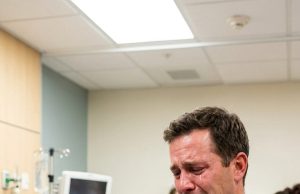
Slowly, almost miraculously, Arthur’s breathing began to synchronize with the dog’s. The frantic beeping of the EKG settled into a steady, comforting thrum. The nurse who had been holding the syringe stepped back, her eyes shining with tears she tried unsuccessfully to blink away.
“I’ve worked this ward for fifteen years, and I’ve never seen a human being able to do that,” she whispered to the doctor.
Sarah wiped her eyes with the palm of her hand, watching the two old souls anchored to one another in the dim light. “It’s because Buster doesn’t care about the facts,” she said softly. “He doesn’t need my dad to know what day it is. He just needs him to know he’s loved.”
The Bridge Across the Fog
Outside the reinforced hospital glass, a distant display of fireworks illuminated the winter sky, marking the arrival of a new year, but inside Room 412, time had ceased to be a linear measurement. Arthur opened his eyes, and for a fleeting, crystalline moment, the fog in his mind seemed to lift, pushed back by the sheer force of the connection he held in his hands. He looked at Buster, then tilted his head slightly toward Sarah, who was standing at the foot of the bed.
“You stayed with me,” Arthur said, his voice surprisingly firm and devoid of the tremors that usually plagued his speech.
Sarah’s breath hitched in her throat as she realized he was looking at her with a flicker of true recognition. “Of course we did, Dad. We aren’t going anywhere.”
Arthur reached out and placed his hand on top of Buster’s head, his fingers tracing the familiar velvet of the dog’s ears. “Don’t you worry about the rest of it,” he murmured, looking directly into the dog’s cloudy eyes. “I haven’t forgotten the important stuff. I remember you.”
Buster let out a soft huff of air and rested his chin on the mattress, closing his eyes in a gesture of total, unshakeable trust. For the first time since the diagnosis had been handed down like a life sentence, the room felt like a sanctuary rather than a battlefield.
Arthur survived that night, and he survived many more that followed. The disease was a relentless thief, and it continued its slow, methodical pilfering of his vocabulary and his motor skills, but the hospital—and later the care facility—maintained a special, unwritten rule. Wherever Arthur went, Buster followed. When Sarah’s face finally became a stranger’s to her father, Buster remained the bridge. When Arthur forgot how to use a fork, Buster sat beside his chair, a silent witness to a life that still held dignity.
On a quiet Tuesday afternoon several weeks later, Arthur woke up as the sun was casting long, golden bars across his room. He looked at Buster, who was lying at the foot of the bed, and a soft, genuine smile transformed his face.
“You found me again, didn’t you?” Arthur whispered, his voice as light as a falling leaf.
Sarah, who was sitting in the corner with a book she hadn’t turned a page of in an hour, came over and took her father’s hand, resting it on the dog’s silver fur. Arthur passed away peacefully that evening, slipping away during a quiet nap while the sun was still high. Buster didn’t move from his post for hours, remaining as a faithful sentry until the very end.
As Sarah finally knelt down to say her final goodbye, she realized that while the illness could steal a person’s history, it was utterly powerless against a love that had been woven into the very fabric of the body. Names are just sounds, and dates are just numbers, but the soul has its own way of keeping the books, and it never forgets the one who stayed when the world went dark.