The Cadence of Safety
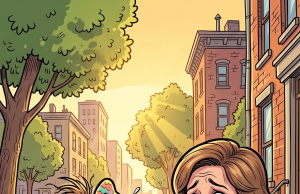
On that particular summer evening in Chicago’s Riverside Park, the sun dipped low beneath the canopy of trees, washing the gravel walkways in a brilliant golden hue. Near the riverfront, street musicians wove lazy notes of soft jazz into the air, children drifted past chasing iridescent bubbles, and the rich scent of roasted nuts mingled with the fragrance of freshly cut grass. By all accounts, the atmosphere should have brought serenity.
To Michael Harper, it tasted entirely of defeat.
He maneuvered the wheelchair with practiced caution, keeping a firm, protective grip on the rubber handles. In a previous chapter of his life, his sheer presence could command an entire corporate boardroom. As the mastermind behind a global logistics conglomerate, Michael was hardwired to dismantle obstacles—rapidly, assertively, and with an endless reserve of capital if the situation demanded it.
Yet, none of his strategic resources had been enough to rescue his son.
Seven-year-old Lucas Harper sat motionless in the seat, his small hands resting loosely in his lap, his gaze anchored to some distant, unseen horizon. Physically, his legs were perfectly sound. A parade of neurological experts had verified that fact across months of testing. There were no severed nerves, no structural spinal trauma, and no underlying physical degenerative conditions.
And yet, Lucas flatly refused to stand.
The paralysis had manifested the exact day Emma, Michael’s wife, vanished from their lives.
She left behind no cryptic note, no frantic explanation. One ordinary morning she was standing in the entryway, kissing Lucas goodbye before the school bus arrived. By the afternoon, she had evaporated into thin air. Within a matter of weeks, Lucas stopped running. Then he stopped walking entirely. Eventually, the silence claimed his voice, too.
Michael had immediately channeled his grief into absolute momentum. He flew in elite pediatric specialists from three separate states, enrolled the boy in cutting-edge experimental therapies, and paid exorbitant fees to private clinics boasting panoramic ocean views and empty promises murmured in sterile offices. Lucas complied passively with every invasive test and every therapeutic session—but the needle never moved.
Ultimately, an elderly child psychologist offered an assessment that Michael’s analytical mind initially rejected.
“Your son’s biology isn’t broken, Mr. Harper,” she explained with immense gentleness. “His internal architecture of safety is what collapsed. He stopped moving because he discovered that the world is a volatile place where the people you love can vanish without a moment’s warning.”
She prescribed a radical change of course: dismantle the medical regime and introduce more unscripted life.
That was the exact reason Michael found himself navigating a crowded charity arts festival in the park, pushing his silent son through a sea of vibrant laughter and social noise that he had absolutely no idea how to bridge.
Lucas watched the other children sprint past his chair. Some tripped on the loose gravel, some shed fleeting tears, but they all ultimately got back on their feet.
He remained entirely detached from the rhythm.
Suddenly, a figure stepped directly into their trajectory.
It was a young girl—perhaps eleven or twelve years old. She was completely barefoot. Her cotton dress was faded from too many washes and frayed along the hemline, her dark hair woven into a loose, unravelling braid that allowed wild strands to frame her face. She carried no satchel, no performance sign, and made no gesture soliciting spare change.
Her focus was absolute.
She wasn’t looking at the wealthy father. Her steady, piercing gaze was locked entirely onto Lucas.
“Hello,” she said, her voice dropping into a calm, melodic register.
Michael’s body instantly went rigid, decades of protective instincts surfacing in a flash. “We aren’t interested,” he stated curtly, already shifting his weight to pivot the wheelchair around her.
The girl didn’t budge from the path.
Instead, she gracefully dropped into a deep crouch, bringing her eyes perfectly level with Lucas’s, treating the mechanical constraints of the wheelchair as if they were entirely invisible.
“Would you honor me with a dance?” she asked the boy. “Just for a single minute.”
Michael’s patience evaporated. “That’s quite enough,” he barked, his voice sharp with authority. “I need you to step away from my son immediately.”
And then, Lucas did something that shattered the routine of the past few months.
He turned his head.
Slowly. Deliberately.
He locked his wide, curious eyes straight onto hers.
“What kind of dance?” he asked, the syllables thin and fragile, but unmistakably clear.
Michael froze, the breath catching in his throat.
The girl offered a small, knowing smile. “The tango,” she answered softly. “It’s fundamentally a walking dance. Just one step at a time.”
A wave of frustration and fear flared within Michael’s chest. False hope was a lethal weapon when you were already broken. “You shouldn’t fill his head with impossible fantasies,” he said, his voice tight.
The girl finally lifted her chin, looking directly up at the father. “I’m not dealing in fantasy, sir,” she said with a striking gravity. “I’m dealing in memory.”
She turned her focus back to Lucas, sitting down cross-legged right there on the rough gravel. “My older sister lost her ability to walk, too,” she shared quietly. “Right after our mother left us behind. She stayed confined to her bed for an entire year. She wouldn’t budge an inch. She wouldn’t speak a word to anyone.”
Lucas swallowed with difficulty, his attention entirely captured. “What did you do?”
“I danced with her,” the girl replied simply. “Not because the movement magically repaired her bones. But because it reminded her spirit that those legs still belonged to her.”
Michael opened his mouth to terminate the interaction—but Lucas cut him off before he could formulate the command.
“Dad,” the boy whispered, his eyes never leaving the girl. “Please let her.”
That single, fragile word carried more weight than any corporate legal brief Michael had ever encountered.
Michael let out a long, shuddering exhalation. “Five minutes,” he conceded, his voice raw. “And I am staying right here by your side.”
The girl offered a solemn nod. “That works for me.”
She placed her hands gently atop the plastic armrests of the wheelchair. “Are you ready to let me help you stand up, Lucas?”
The boy hesitated, his knuckles whitening as he gripped the frame. The muscles in his calves began to twitch with a violent tremor.
“I’m going to collapse,” he whispered into the space between them.
“Then I’ll collapse right alongside you,” she responded without a moment’s hesitation. “That’s just part of the choreography.”
With Michael hovering mere inches away, his hands poised to intervene, Lucas slowly shifted his weight toward the edge of the cushion. The girl began a soft, rhythmic count—one, two—and Lucas’s bare soles made contact with the earth.
His alignment wobbled dangerously.
Michael lunged forward—
“I’ve got his balance,” the girl directed, her posture entirely steady and unshakeable.
Lucas stood.
For one profound, terrifying second.
Then he sustained it for another.
Tears burned the backs of Michael’s eyes as the young stranger methodically guided his son’s feet—one microscopic forward shift, followed by another. She began to hum a low, primitive cadence under her breath, establishing a foundational rhythm, steering the boy not with physical leverage, but with absolute conviction.
The ambient chaos of the park dissolved into complete silence.
After navigating three full steps, Lucas’s strength gave out, and he dropped safely back onto the leather of the chair, breathless, his chest heaving—and his lips curved into a radiant smile.
“I actually did it,” he gasped, pure disbelief fracturing his tone.
The girl beamed with pride. “You didn’t learn anything new, Lucas. You just remembered.”
Michael’s hands were shaking so violently he had to bury them in his pockets. “Who are you?” he managed to ask, his voice thick.
She gave a light shrug of her shoulders. “People call me Clara.”
“Where is your family?”
She cast a quiet look toward the dark waters of the river. “They aren’t in the picture anymore.”
Michael swallowed the lump in his throat, the reality of her appearance clicking into focus. “You’re living on the streets.”
Clara didn’t offer a defense or a denial. She simply looked back at Lucas.
Finding the Rhythm
That night, sleep eluded Michael entirely.
Across the hall, Lucas was equally restless.
“I need to find Clara again, Dad,” Lucas announced the following morning over breakfast, a spark in his eyes that had been missing for a lifetime. “She didn’t look at me like I was a broken machine that needed to be fixed.”
Michael returned to Riverside Park every single afternoon without fail.
On the fourth evening of their search, they finally spotted her silhouette—watching a group of performance artists near the open-air amphitheater. This time, Michael didn’t voice a single objection.
Over the sequence of the next few weeks, Clara became a permanent fixture in Lucas’s daily reality. They danced across the grass every afternoon. On some days, his legs co-operated; on others, they didn’t. But through the process, the silence broke. He laughed loudly. He vocalized his thoughts. He argued about petty things. He was finally participating in life again.
Michael pieced together Clara’s history through fragments of conversation. Her mother had passed away years ago, and her father had systematically drifted out of existence. She survived entirely on her wits—assisting tourists with their luggage, dancing on the boardwalk for loose change, and seeking refuge in local shelters whenever the weather turned hostile.
“She doesn’t want our pity, Dad,” Lucas lectured his father fiercely one evening after a session. “She deserves a home.”
The statement burrowed deep into Michael’s conscience, refusing to let him rest.
A few days later, after watching Lucas successfully navigate five full steps across the lawn entirely unassisted, Michael walked over and dropped down onto one knee before the young girl.
“Come live with us, Clara,” he said, his voice steady and completely unadorned.
Clara stared at him, a sudden flicker of institutional suspicion crossing her features. “Why would you offer me that?”
“Because you didn’t treat my son like a medical diagnosis,” Michael explained softly. “You reminded him of his own humanity. And it is high time someone stepped up to do the exact same thing for you.”
Clara didn’t say a word, but silent, heavy tears began to track through the dust on her cheeks.
The Performance
Months later, Lucas walked through the grand double doors of his elementary school, the wheelchair left permanently in the garage.
Clara occupied a prime seat in the very front row of the auditorium during his winter recital, her dark hair meticulously braided, a pair of brand-new leather shoes on her feet for the first time in her memory.
The moment the orchestra struck the opening notes, Lucas took a confident step out onto the polished wood of the stage—and began to dance.
And watching from the wings, Michael finally understood the core truth of his journey:
True healing can never be manufactured through wealth or structural power.
It materializes only when a fragile soul is truly seen by another.
One step at a time.