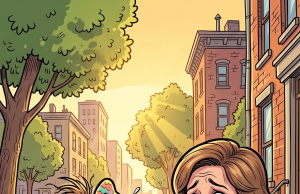
Roberto’s car stalled two blocks from the gate.
It was the kind of misfortune that would normally make him snap at someone—his driver, his mechanic, the universe. But this time he welcomed it, because the silence fit his plan. He wanted to arrive like a shadow, to witness the truth with his own eyes before anyone could scramble to hide it.
He stepped out into the pale morning, adjusted the knot of his red tie, and felt it press against his throat like a hand. He hadn’t slept properly in days. His mind had been looping the same fear again and again: What if I’ve brought a stranger into my son’s life… and she’s not who she pretends to be?
Three days earlier, he had announced a business trip overseas—some conference, some meetings, the usual story people accepted from wealthy men without question. He had even packed a suitcase and made a show of leaving. But there was no flight. No conference. There was only a hotel room downtown where he sat awake, staring at the clock, imagining sounds in an empty mansion: crying, neglect, carelessness.
It had been just a month since he hired Elena.
The agency had been cheap and fast, which should have warned him, but the truth was that no experienced nurse wanted the job. Roberto’s home was heavy with grief. His temper had hardened into something sharp since the day his wife died in childbirth. He was polite to outsiders, but inside those walls, he was a man living on the edge of panic, watching his one remaining miracle with obsessive terror.
Pedrito—Pedro Martín—was one year old. Fragile. Small. Beautiful in the quiet way babies are when they don’t realize the world is already trying to label them.
The specialists had given Roberto words that felt like prison bars: irreversible weakness, partial paralysis, unlikely to walk independently. One doctor, the most expensive neurologist in the city, had told him gently, almost kindly, to “adjust expectations.”
Roberto didn’t adjust. He built a fortress.
He bought a wheelchair shipped from Germany, sleek and silver, padded like royalty. He hired therapists who spoke in technical language and carried equipment in black cases. He instructed everyone the same way, over and over: Don’t let him strain. Don’t let him crawl too much. Don’t let him fall. Keep him safe. Keep him still.
He told himself it was love.
But love had become fear wearing a father’s face.
The neighbor, Doña Gertrudis, was the match that lit his suspicion. She was the kind of woman who watched life from behind curtains and called it concern. She caught Roberto one afternoon along the boundary of their properties and leaned in as if sharing a secret.
“Roberto,” she said, sugar in her voice and poison beneath it, “that new girl… she’s odd.”
He had paused, instinct tightening.
“What do you mean?”
“I hear shouting,” Gertrudis whispered. “Furniture scraping. And then—music. Loud music. In a home with a sick child? Be careful. People who smile too much often hide the worst things.”
Those words burrowed into Roberto’s mind like splinters. He tried to ignore them. He tried to tell himself he was being paranoid. But at night, when Pedrito slept in his expensive room surrounded by medical devices and untouched toys, Roberto stared at the ceiling and saw worst-case scenes on repeat.
So he set a trap.
And now he was back, walking the last blocks to the mansion, using his master key, turning it slowly to avoid the click.
The house smelled like disinfectant and loneliness.
He stepped onto the polished floor. Silence.
One step more. Still nothing.
Then he heard it.
Not the crying he expected. Not television noise. Not the dull background of negligence.
It was laughter—bright, explosive, unfiltered laughter.
It came from the kitchen.
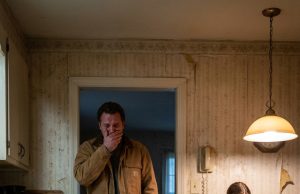
Roberto’s blood turned hot. His hand tightened around his leather briefcase until his knuckles whitened.
She’s laughing while my son suffers.
Anger rose fast and blind. He imagined Elena on the phone, flirting, treating his home like a vacation job while Pedrito sat strapped to his chair, bored and ignored. He no longer walked quietly. His shoes struck the hallway in sharp echoes as he moved toward the sound.
He reached the kitchen doorway ready to roar.
The words died in his throat.
The scene inside looked like it belonged to another universe.
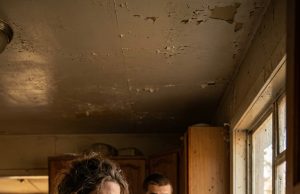
Sunlight poured through the wide window, turning the steel counters warm and gold. On the tiled floor lay Elena—flat on her back, hair fanned out, wearing her uniform and absurdly bright gloves. She looked… happy. Not smug. Not careless. Happy like someone who had forgotten to be afraid.
And above her—
Pedrito wasn’t in his wheelchair.
The chair sat empty near the refrigerator like an abandoned cage.
Pedrito stood on Elena’s stomach, wobbling, tiny feet pressing into fabric, a crooked chef’s hat on his head like a crown. His arms lifted in triumph. His mouth opened wide in pure, delighted sound.
He was laughing.
Roberto’s brain refused to accept what his eyes were feeding him. The medical report in his safe screamed impossible. The specialists’ warnings screamed danger. But the child in front of him looked alive in a way Roberto had not seen in months.
The sh0ck shifted into terror.
If Pedrito fell from that height onto hard tile, he could break something. Worse. Roberto’s fear turned to fury because fear always did in him—it needed an outlet.
“What are you doing?” he thundered.
Elena snapped her gaze to him, startled—but her hands tightened around Pedrito’s ankles, not to push him away, but to steady him. She didn’t flinch like a guilty woman. She moved like someone protecting a child.
Pedrito, jolted by his father’s voice, lost his balance for a second. Roberto lunged forward on instinct.
“Let him go!” Roberto barked, arms out. “You’re going to hurt him!”
Elena’s expression flashed with anger, but she didn’t argue with her hands. She lowered Pedrito quickly, keeping his body safe.
Roberto shoved past her, grabbed his son, and held him tight against his chest as if the world might steal him again.
Pedrito began to cry—not in pain, but in outrage. He reached his arms toward Elena, desperate, as if she were the one he trusted to keep the game alive.
That stung worse than any insult.
“You’re fired,” Roberto spat at Elena, voice shaking with adrenaline. “Pack your things. Now. If you’re still here in five minutes I’ll call the police.”
Elena rose slowly. She removed her gloves with unbearable calm and set them on the counter like a statement.
“Mr. Roberto,” she said, low and steady, “he isn’t crying because he’s hurt. He’s crying because you stopped his victory.”
Roberto laughed bitterly.
“Victory?” He tightened the wheelchair belt again as if locking a door. “That’s what you call it? I call it reckless. He’s disabled.”
The word landed in the kitchen like a stone.
Pedrito sniffled and stared at his father with wide wet eyes, then looked back at Elena as if asking her to undo what had just happened.
Elena’s gaze sharpened.
“That’s the difference between you and me,” she said quietly. “You love the child you wished you had. I love the child in front of me.”
Roberto’s breath caught.
“How dare you.”
Elena stepped forward, fearless. “You think the wheelchair is his future. I think it’s an obstacle.”
Roberto’s mind flashed to the neurologist’s office: the hum of air conditioning, the sterile smell, the doctor’s voice explaining nerve pathways and cautioning against forcing movement. Roberto had clung to those words like law because law meant certainty, and certainty meant he didn’t have to risk hope.
“You don’t know medicine,” he snapped. “You’re here to clean. Not to play miracle worker.”
Elena didn’t retreat. Instead she reached into her bag and pulled out an old notebook—worn cover, pages filled with neat handwriting and childish doodles.
“Open it,” she said, sliding it across the counter. “Read the last page. Then decide.”
Roberto hesitated. Something in her tone felt heavier than defiance. It felt like truth.
He flipped through the notebook.
Day one: wiggled left big toe.
Day four: moved hips to music.
Day twelve: supported weight for three seconds.
And on today’s page, the ink still fresh:
9:15 AM — Pedro stood without being held.
Roberto’s stomach dropped.
“That’s… that’s a lie,” he whispered, slamming the notebook shut. “You wrote it because you knew I was coming.”
Elena’s voice softened, not in surrender, but in pity. “Science can’t measure a child’s will to reach the person who makes him feel safe.”
Roberto’s anger rose again, desperate to save him from shame. If Elena was right, then Roberto had been wrong—and that meant he had stolen a year of his son’s life, trapping him in stillness because fear felt like protection.
“Prove it,” Roberto said, harsh. “Right now. Put him on the floor. Let him stand without you.”
Elena nodded once.
She unbuckled the belt Roberto had tightened too hard. Pedrito’s face brightened the second she touched him. He reached for her like she was sunlight.
Elena set him on the tiles—not laying him down, but standing him upright. Her hands supported his waist. Roberto’s heart hammered. His entire body prepared for collapse.
“Let go,” Roberto demanded.
Elena looked into Pedrito’s eyes. “You can do it, champion. Find your balance.”
Then she removed her hands.
Time slowed.
Pedrito wobbled violently, knees trembling like reeds in wind. Roberto’s hands twitched, ready to catch him.
Pedrito didn’t fall.
One second.
Two.
Three.
Roberto’s mouth parted in disbelief.
Pedrito took a step—ugly, unsteady, but real. Then another. Two small steps toward his father.
Roberto stumbled backward as if hit.
The child collapsed onto his diaper with a soft thump, and instead of crying, he clapped his hands, waiting for applause.
Elena knelt, tears bright in her eyes. “Bravo,” she whispered.
Roberto couldn’t move.
The miracle was not polished. It was not cinematic. It was messy, shaky, human. And it shattered everything he’d believed.
Roberto’s shame arrived like a tidal wave.
And shame, in him, always tried to transform into anger—because anger was easier than admitting he’d been the prison guard.
But Pedrito looked up, smiling, and something inside Roberto cracked open.
He sank to his knees on the floor.
The expensive suit tightened. The tiles felt cold. The angle of the world changed. Suddenly the furniture looked huge and Pedrito looked like a giant.
Elena watched, silent.
Roberto whispered, raw: “He… he’s afraid of me.”
“He’s not afraid of you,” Elena said gently. “He’s afraid of the stranger you’ve been in his world.”
Roberto stared at his hands—hands that signed contracts, moved money, controlled outcomes. Hands that didn’t know how to play.
Elena nudged one of the homemade cans filled with sand toward him. “Offer him something.”
Roberto shook it. A soft rhythmic sound.
Pedrito looked.
Roberto tried again, forcing a clumsy smile.
And then, choosing humiliation over pride, Roberto balanced the can on his head like a clown. It fell and rolled.
Pedrito burst into laughter.
The sound hit Roberto like a blessing.
He crawled forward on all fours, ruining his suit, making ridiculous noises that weren’t quite engine sounds or animal sounds, but they made Pedrito squeal anyway. Pedrito lunged—two awkward steps, a stumble—and fell into Roberto’s chest.
Roberto wrapped his arms around him, not like a man holding something fragile, but like a father holding something loved.
He cried openly. Years of frozen grief finally thawed.
“Forgive me,” he whispered into Pedrito’s neck.
Pedrito touched his wet cheek with a sticky hand. “Daddy,” he said.
Roberto closed his eyes, feeling his son’s legs kick softly against him—not dead weight, but living muscle.
Elena’s voice came quiet from nearby. “You feel it now, don’t you?”
Roberto nodded, unable to speak.
Then Elena told him why she had dared to disobey.
She spoke of her little brother, Luis, born with the same weakness, in a town without doctors or money. She had been ten, forced to become his world. She had made up games, methods, encouragement. She had refused to let neighbors bury him in pity.
“He walked,” Elena said softly. “Slowly, but he walked. And when I saw Pedrito in that chair, I saw my brother again. I couldn’t watch that light die.”
Roberto listened like a man hearing the truth for the first time in his life: that love was not a cushion. Love was a push. Love was consistent, exhausting, daily.
That day changed everything.
Roberto turned off his phone when business called. He began ripping danger out of the house—glass tables, sharp corners, sterile décor. He replaced them with mats, space, noise, life.
He asked Elena to teach him everything: the games, the makeshift tools, the massages, the music.
“Money is worthless down here,” Elena said, tapping the floor. “Only your heart has value.”
Three months later, Roberto carried that lesson into the neurologist’s office.
Dr. Valladares looked at Roberto with practiced pity and scolded him for canceling therapy sessions, for refusing the new motorized chair. Roberto didn’t argue. He simply said, “Watch.”
Pedrito hesitated in the cold clinic, frightened by the white lights, the lab coat, the smell of fear. Roberto’s old panic clawed up his throat.
Elena crouched beside Pedrito and whispered a game into his ear: an ice cave, a treasure, a finish line.
She opened her arms across the room.
Pedrito let go of his father’s leg.
And he walked—step by trembling step—until he fell into Elena’s embrace.
The doctor went pale, searching for explanations that couldn’t contain the moment.
Roberto leaned forward, calm as steel. “Update the file.”
Outside, the world felt wider.
Later, in a park filled with grass and children and barking dogs, Roberto tried to repay Elena with money—a trust, a lifetime income, freedom.
Elena tore the papers in half.
“You still think I’m here for what you have,” she said. “My freedom is watching him live. This is my family.”
Roberto held her hand, not as an employer, but as a man learning to walk too.
Years passed.
Pedrito grew into a boy with a slight limp and an unbreakable spirit. He climbed steps on stage at preschool festivals while strangers held their breath. He slid across soccer fields without fear of the ground, because the ground had been his teacher.
And Roberto—once the richest man in a cold mansion—learned that the greatest fortune he would ever hold was not locked in a safe.
It was the sound of his son laughing on a kitchen floor.
It was the courage to kneel, to get dirty, to trust.
And the day he finally understood that, the mansion stopped being a museum of grief…
…and became a home.