The Legion of the Quiet Heart
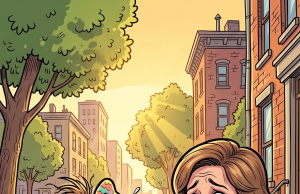
Mabel huddled on the sun-bleached concrete of the suburban sidewalk, her small frame curled into a protective arc over Silas. She held him with a desperate, white-knuckled intensity, her fingers tangled in his golden fur as if she could somehow absorb the cruelty of the world before it reached him. Her palms were stained with the gray grit of the driveway and raw from where she had collapsed onto the pavement, but she didn’t feel the sting.
Strewn across the yard like the skeletal remains of a forgotten toy were the fragments of what had been Silas’s world: shattered white PVC piping, jagged shards of plastic, and two black wheels that had rolled into the gutter. That makeshift assembly of hardware store parts and Velcro straps had been more than a contraption; it was Silas’s wheelchair. He was a Golden Retriever mix with a spirit far larger than his body, though he had lost the use of his hind legs long before Mabel had found him at the county rescue. For Silas, that rattling plastic frame had been the difference between being a spectator and being a participant. It was his only way to chase the wind, his only way to explore the neighborhood, and his only way to keep pace with the little girl who was his entire universe.
Mabel was ten years old, though she carried the heavy, watchful stillness of someone much older. Ever since her father had been taken in a sudden highway collision two years prior, she had retreated into a silent, interior fortress. The roar of the modern world—the screeching tires, the shouting voices, the unpredictable clamor—paralyzed her. She had almost entirely ceased to speak, finding the architecture of words too fragile to build. The only soul she truly trusted, the only one who didn’t require her to explain her sorrow, was Silas.
Every afternoon, the two of them would navigate the three blocks to the local park. It was a pilgrimage of sorts, but for the last month, it had become a gauntlet. A group of older teenagers from the next street over had made them a target. They didn’t just mock Mabel’s silence; they targeted Silas’s disability. They would pedal their mountain bikes inches from his wheels, toss heavy pinecones at his head, and jeer that a “broken” dog belonged in a scrap heap. They called Mabel a “freak” who was too broken herself to even scream for help.
Mabel never retaliated. She would simply lean down, cover Silas’s ears so he wouldn’t hear the malice, and quicken her gait, her eyes fixed on the pavement.
But on the humid afternoon before Mabel turned eleven, the cruelty escalated into something physical. The boys formed a bicycle blockade across the sidewalk, their sneering faces backlit by the harsh Georgia sun. When Mabel tried to maneuver Silas around them, the largest boy stepped forward with a heavy work boot and delivered a single, crushing kick to the axle of the wheelchair. The brittle plastic snapped with a sound like a gunshot.
Silas tumbled violently onto the concrete, his front legs scrabbling for purchase as he became hopelessly entangled in the twisted Velcro and shattered pipes. He let out a sharp, panicked yelp that pierced the heavy air. As Mabel dropped to her knees, her face wet with silent tears as she tried to free her best friend from the wreckage, one of the boys produced a thick piece of yellow sidewalk chalk. With slow, deliberate strokes, he scrawled a message on the driveway right next to her trembling hands.
It said they were both useless, a pair of discarded things that should stay locked inside where the world wouldn’t have to look at them.
Mabel eventually managed to carry Silas into the house, her breath coming in shallow, jagged gasps. She bolted the front door, retreated to the furthest corner of her bedroom closet, and pulled a heavy quilt over them both. When her grandfather found her, she whispered the first words he had heard from her in weeks: she was never going out again.
Her grandfather, Arthur, was a man of few words and a very long memory. A retired Army combat medic who had seen the worst of humanity in the mountains of the Hindu Kush, he didn’t erupt in a fit of rage. He didn’t storm across the street to confront the parents of the boys, nor did he file a report that he knew would result in nothing more than a lecture. Instead, he sat on the floor of the closet, gently wiped the grime from Mabel’s cheeks, and applied a soothing salve to a scrape on Silas’s paw. Then, he walked into the kitchen, sat at the wooden table, and made exactly one phone call to a regional veterans’ outreach center.
The Sound of Approaching Thunder
The following morning marked Mabel’s eleventh birthday, but the house felt like a tomb. She refused to leave the safety of her covers, the curtains drawn tight against a world she no longer wished to inhabit. The silence was absolute, a heavy shroud that seemed to muffle the very ticking of the hallway clock.
Until exactly nine o’clock.
It began as a low, subsonic vibration that Mabel felt in her teeth before she heard it with her ears. It was a rhythmic, unified thrum—the steady, synchronized crunch of heavy soles hitting asphalt. Accompanying the cadence was the metallic, melodic jingle of dozens of heavy dog collars. The sound swelled, growing in volume until the floorboards beneath Mabel’s bed began to hum with the energy of it.
Compelled by a flicker of curiosity that overrode her fear, Mabel crept to the window and parted the heavy fabric of the curtains by a single inch. Her breath hitched, and she felt a tingle of electricity run down her spine.
There were no flashing sirens or shouting officials. Instead, there was a literal legion marching down her quiet, oak-lined street.
Fifty combat veterans, men and women of various ages and backgrounds, were moving in a perfect, disciplined column. Some wore weathered flight jackets; others had unit patches stitched to their caps. And walking in perfect, silent harmony beside each of them were fifty massive service animals. There were dark-coated German Shepherds, sleek Belgian Malinois, and broad-chested Labradors, all moving with a focused, professional intensity. They didn’t bark. They didn’t stray. They simply marched.
The formation halted directly in front of Mabel’s yard. They stood shoulder to shoulder, fifty soldiers and fifty guardians, creating an impenetrable fortress of muscle and protective intent around the small house.
A tall, weathered man with silver hair stepped out from the center of the line. He moved with a pronounced limp, leaning on a sturdy wooden cane, while a charcoal-black Shepherd walked at his side, matching his pace with surgical precision. The man ascended the driveway and knocked firmly on the front door. Arthur opened it, holding Silas in his arms. Mabel stood hidden behind her grandfather’s legs, her eyes wide as she took in the sheer magnitude of the assembly on her lawn.
The tall man slowly lowered himself into a crouch, his jaw tightening slightly as he favored his bad leg, until he was at eye level with the terrified girl.
His voice was a deep, resonant baritone, yet it carried a gentleness that didn’t feel like a threat. “In our world, Mabel, we have a code that never expires: we never leave a brother or sister behind, and we don’t let anyone mess with our squad.” He pointed a hand, scarred by years of service, toward Silas. “From this second on, you and Silas are part of our unit. And we take care of our own.”
A woman stepped forward from the formation, carrying a large object shrouded in a heavy moving blanket. She knelt on the porch and pulled the fabric back with a flourish.
Mabel let out a soft, audible gasp. It was a wheelchair for Silas, but it bore no resemblance to the fragile plastic one that had been destroyed. This was a masterwork of industrial design, crafted from shimmering, aircraft-grade aluminum with thick, all-terrain rubber tires and reinforced suspension. Welded into the side plate, sitting proudly next to a polished gold military star, was a nameplate that read: SILAS.
The woman smiled at Mabel, her eyes crinkling at the corners. “I used to be a combat engineer, honey. I spent my life fixing the gear that kept our boys safe. My unit heard a rumor that a very brave dog needed a new set of wheels, so I pulled an all-nighter to build him the fastest chariot on this side of the Mississippi.”
They carefully strapped Silas into the new harness. For a moment, the dog stood perfectly still on the porch, his ears pricked as he tested the weight and the effortless balance of the machine. Then, he took a tentative step. The heavy-duty bearings glided silently over the wood. Silas looked up at Mabel, let out a massive, chest-vibrating bark of pure joy, and suddenly accelerated down the driveway, his tail wagging so hard his entire body blurred.
Mabel found herself running after him, her laughter breaking through the silence for the first time in years. The fortress was no longer her closet; the fortress was now the fifty men and women who stood watching her with quiet pride.
The lead veteran stood up and leaned on his cane. “Well, Mabel,” he said, a ghost of a smile playing on his lips. “It’s a beautiful afternoon. Are you ready to take your squad for a walk?”
Mabel wiped her eyes, grabbed Silas’s leash with a firm hand, and stepped off the edge of the porch with her head held high.
The Silence of the Park
The moment Mabel’s foot hit the sidewalk, the fifty veterans and fifty service dogs pivoted as one and fell into step behind her. They didn’t lead; they followed. They formed a massive, impenetrable vanguard that shielded a ten-year-old girl and her three-legged dog from the rest of the world.
When they reached the entrance to the park, the older boys were already there. They were lounged across the aluminum bleachers, tossing a baseball back and forth with an air of casual arrogance. The largest boy looked up, expecting to see a lonely girl he could bully, but the ball slipped from his fingers and rolled into the dirt as he froze in place.
The bullies watched in a state of absolute, paralyzing terror as fifty hardened veterans and fifty professional guardians systematically surrounded the entire perimeter of the park. The soldiers didn’t utter a single syllable. They didn’t shout insults, and they didn’t make threats. They didn’t have to.
They simply stood there, arms crossed over their chests, their shadows long and imposing across the grass. They stared directly at the boys who had found sport in breaking a disabled animal. Beside them, the service dogs sat in a state of preternatural stillness, their intelligent, unblinking eyes locked onto the teenagers with a terrifyingly calm focus. The silence in the park was so heavy it felt like a physical weight, pressing the air out of the boys’ lungs.
The teenagers scrambled off the bleachers, their faces pale and their bravado evaporated. They grabbed their bicycles, nearly tripping over one another in their desperate haste to escape, and pedaled away as fast as their legs could carry them. They never returned to that park, and they never again set foot on Mabel’s street.
But the veterans didn’t simply vanish after that afternoon. They were soldiers, and in their world, a promise made was a debt that had to be honored. They established a rotating schedule that became a permanent fixture of the neighborhood.
Every single afternoon, regardless of the weather, at least two veterans and their service animals would arrive at Mabel’s front gate. They would walk with her and Silas, providing a quiet, steady presence that allowed Mabel to find her own voice again. While Silas zoomed around the grass on his aluminum wheels, the veterans taught Mabel how to work with the dogs. They taught her the commands, the posture of authority, and the importance of looking the world in the eye. They showed her that being quiet wasn’t the same thing as being weak.
The Changing of the Guard
A decade passed, and the rhythm of the neighborhood shifted. Silas eventually passed away in the fullness of time, a peaceful departure in his favorite sunspot with his head resting on Mabel’s lap. He had spent his final years as the fastest, most loved dog in the county, running on wheels that never broke.
Mabel was twenty years old now. She stood in the center of a wide, sun-drenched training field on the outskirts of the city, wearing a sturdy canvas training vest and holding a silver clicker in her hand. Her voice, once a buried secret, was now clear and authoritative as she worked with a young Malinois.
The gate to the facility creaked open, and a young man walked through. He was a veteran, recently returned, and he moved with a visible tremor in his hands. His eyes darted around the open space, wide with the hyper-vigilance of a soul that had seen too much and was struggling to carry the invisible weight of his memories into the daylight.
Mabel walked toward him, her stride confident and her gaze steady. She didn’t look away from his discomfort; she looked him directly in the eye with a warm, knowing smile.
She reached behind her and brought out a young, eager Golden Retriever puppy wearing a bright green “Service Dog in Training” vest. She took the leather lead and placed it firmly into the soldier’s trembling hand.
Mabel guided the dog to sit directly against the man’s leg, the animal’s warm weight acting as a grounding anchor for his spiraling thoughts. She looked at the soldier, her voice soft but unbreakable.
“This dog is going to be your shadow,” she told him. “He’s going to watch your back, keep you grounded, and make sure you never have to navigate the dark alone. He’s part of your squad now, and we never leave a teammate behind.”
She stood there, a guardian who had once been saved by a legion, now leading her own, and as the soldier’s hand finally steadied in the dog’s fur, she knew that the march would never truly end. It was a cycle of loyalty that had started with a broken plastic wheelchair and a little girl’s silence, and it would continue as long as there were souls in the dark who needed someone to walk beside them.