The Architecture of a Rising Tide
The rain did not descend with the dramatic flair of a cinematic disaster. It began as a mere atmospheric nuisance, a thin, silver veneer on the asphalt that shimmered under the city lights. It was a persistent, rhythmic tapping on the canvas tarps of the local street markets, a gray Tuesday afternoon that forced vendors to shield their wares with sheets of crinkled plastic while pedestrians quickened their pace toward the subway. But on the outskirts of the district, where the industrial canal acted as a dark artery for the city’s runoff, these subtle shifts were always a grim foreshadowing.
The water level rose with a discreet, almost polite steady climb at first, but it soon became a hungry, swelling force. By the time the neighborhood realized that the clouds had moved past a simple storm into the territory of a catastrophic flood, the current was already moving with a predatory violence. Many things had already been swept into the churning brown depths, carried too far into the darkness to ever be retrieved by human hands.
In a hidden hollow shielded by thick weeds, damp cardboard, and the rotting remnants of plywood, a stray dog had constructed her meager world. It was a place defined by the smell of wet earth and the distant hum of traffic, a corner chosen because the concrete embankment offered a sliver of protection against the wind. It was a stinking, neglected edge of the canal where no person ever bothered to tread, and it was there that she had given birth.
She had brought four lives into the world in the freezing mud, alone and without the comfort of a blanket or the safety of a steady food supply. Her own body had served as the roof, the wall, and the shield while she performed the brutal, instinctive work of nursing her young. Four tiny, lukewarm heartbeats—four blind, squirming reasons to keep breathing even when her own ribs ached with a persistent, gnawing hunger.
The Choice Made in the Mud
The morning had dawned under a sky the color of a bruised plum, but the mother dog had weathered storms before. She had spent a lifetime trembling under highway overpasses and learned to distinguish between an annoying drizzle and a lethal deluge. The problem was that the geography of the canal changed with a terrifying speed that day. Initially, thin threads of water began to seep into the hollow where the puppies lay huddled. Then, the soaked cardboard disintegrated, losing its ability to insulate. Finally, the very earth beneath the shelter gave way.
The mother sat bolt upright, her nose twitching as she tasted the metallic scent of the rising current. The puppies, still clumsy and unaware of the encroaching danger, searched for her belly in the dark. Then came the first heavy blow of the flood—not a massive wave, but a low, dirty surge that rushed beneath the rotting wood and transformed their sanctuary into an icy, swirling puddle.
She did not hesitate. She gripped the first puppy by the scruff of its neck and scrambled up the slick dirt slope to the high concrete ledge, depositing the small life among the roots of an ancient willow. She returned for the second, and then the third, each journey becoming a grueling battle as the water reached her chest and the rain lashed against her eyes.
When she returned for the fourth puppy—the smallest of the litter—the hiding place had vanished. The earth had surrendered to the canal, and the puppy had been swept away. He wasn’t gone, but he was no longer where she had left him. The current had dragged him several yards downstream, trapping him in a jagged pocket of debris and broken branches pressed against the rough canal wall.
The Sentinel on the Bridge
The mother jumped without calculating the height or the force of the water. She saw only her child drifting toward the center of the roar. She dove into the brown waves, her teeth finding the delicate skin of the puppy’s neck with surgical precision, just enough to hold him without causing harm. But the rescue was only half the struggle; now she had to ascend.
The canal wall was high, unforgiving, and lubricated by a thick layer of grease and mud. She stood on her hind legs, her front paws clawing at the concrete, but she slipped back into the cold every time. Above her, the other three puppies waited, unable to comprehend the magnitude of the loss that was unfolding beneath them. The water roared in a deafening, monotonous tone, and the air smelled of wet fur and absolute fear.
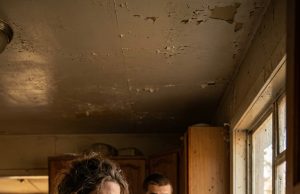
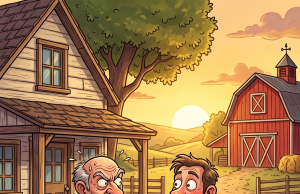
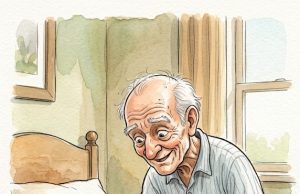
A few dozen yards above the struggle, an elderly man named Arthur was crossing the footbridge, hunched beneath the skeletal frame of a broken umbrella. He wasn’t out for a stroll; he had just sold his last set of vintage wrenches to pay for his heating bill and was returning home with a few heavy coins in his pocket and his boots soaked through. Arthur was a man who had long ago ceased to expect much from the world. He had learned to walk with his head down, avoiding the jagged edges of other people’s pain because a man of his age and means could not possibly save everyone.
But some scenes possess a gravity that breaks even the most hardened heart. He heard a sound that was neither a bark nor a human cry—a hoarse, persistent groan that vibrated with the frequency of a final farewell. He peered over the stone railing and saw her.
The dog was positioned almost vertically against the wall, her muscles shaking with a profound exhaustion, a tiny puppy dangling from her jaws. Arthur stopped breathing for a second, convinced she would vanish beneath the surface at any moment. He thought about walking away, because the habit of powerlessness is a difficult one to break, but then his eyes landed on the three puppies huddled on the ledge above. They were wet, immobile, and clinging to each other as if awaiting a judgment they didn’t deserve.
The Strength of an Outstretched Hand
“Lord, help me,” Arthur whispered, his voice cracking as he scrambled down the side slope, clutching a rusted railing and cursing the stubborn stiffness in his knees.
Halfway down the embankment, he shouted for help. Across the street, sheltered under a flickering blue tarp, a young man named Silas was serving hot coffee to drivers who had been stranded by the rising waters. Silas didn’t ask for a detailed explanation; one look at the old man’s face and the direction of his gaze told him everything. He abandoned his thermos and sprinted toward the canal.
The mother was losing her grip. Her legs slipped more frequently now as plastic bottles and jagged branches struck her flanks. Arthur lay face down on the freezing concrete edge, his arm extended until his shoulder burned with a white-hot agony. Silas knelt behind him, gripping Arthur’s ankles with a white-knuckled intensity to prevent him from being pulled into the depths.
“Just a few more inches, Arthur!” Silas yelled over the wind.
The dog raised her eyes to meet Arthur’s. She didn’t growl or bare her teeth; she lacked the energy for suspicion. But she also refused to let go of the puppy to accept his hand. Arthur saw a fierce, primal decision in those eyes—an animal that would rather drown than let her child fall back into the brown waves.
“Give him to me, girl,” Arthur crooned, his tone a low, grounding hum. “I’ve got you both. I promise.”
The dog slipped, half her body disappearing into the water before she surged upward again, her paws finding a temporary purchase on a long branch Silas had shoved into the mud to act as a brace. It wasn’t a perfect plan, but it was enough. Arthur finally managed to grasp the loose skin of her neck and shoulder. With a clumsy, desperate heave, the two men hauled the mother up, her chest hitting the concrete with a heavy thud as she gasped for air.
The Life Hidden in the Shadows
Even on solid ground, she did not release the puppy until Arthur gently pried him from her teeth. He placed the little one next to his brothers, and the three survivors immediately piled on top of him, seeking a warmth that was no longer there. But as Arthur looked back at the mother, he saw Silas staring at a fifth bundle hidden among the wet roots—a small, motionless lump of fur that the mother had returned for earlier.
Silas knelt and touched the soaked animal with two fingers. “He’s still lukewarm, Arthur. There’s a chance.”
They didn’t really know what they were doing, but they followed an ancient intuition. Silas ran to his stall and returned with a jute sack and a thin towel. They wrapped the fifth puppy and began to rub him with a gentle, persistent pressure, trying to coax life out of the cold. The mother dog tried to stand, falling once before dragging herself toward the bundle. She sniffed him and began to lick his face with a frantic, rhythmic devotion.
After a long minute of silence, the puppy gave a microscopic shudder. “He moved,” Silas breathed, his eyes wide with a sudden, soaring hope.
Arthur used his last bit of phone battery to call a local animal rescue contact he had saved years ago. A woman named Elena answered with a tired, weary voice, but she didn’t ask for unnecessary details. She told them to wait, that the streets were closed but she would find a way.
Wait. It is a word that sounds simple until the cold begins to seep into your marrow and life is measured in the minutes between breaths. Silas moved the entire family under his tarp, and the stranded drivers stopped their complaining to help. One offered a plastic crate; another found an old wool blanket in his trunk. In the presence of such raw, unadulterated pain, the indifference of the city finally began to dissolve.
The Architecture of Redemption
Elena arrived forty minutes later in a white van that was caked in mud to the door handles. She checked the mother first, her expression hardening as she cataloged the torn pads, the dehydration, and the signs of a systemic infection. “She’s at her absolute limit,” Elena said, but she said it with the experience of someone who knew that limits were meant to be pushed.
They loaded the crate into the van, and Arthur and Silas followed. In the emergency clinic, the contrast was jarring—the sterile smell of disinfectant and the bright, unforgiving white lights. The mother, whom Elena decided to call Nala so she could speak to her as a soul rather than a statistic, was placed on a thermal table. The puppies were stabilized one by one, though the fifth—the one from the mud—remained in critical condition.
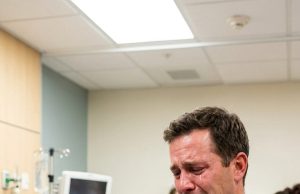
Arthur and Silas waited in the hallway, two strangers who had been forged into companions by the events of the afternoon. They talked about the rain, the city, and the peculiar way a man can live for years next to a canal without ever realizing a miracle was beating against the edge. Hours later, Elena emerged with a weary but genuine smile.
“Nala is going to make it,” she announced. “And so are the four boys. The little one is still fighting, but he’s breathing on his own.”
Arthur felt a weight lift from his chest that he hadn’t realized he was carrying. Over the next several weeks, he became a fixture at the clinic. He brought broth for Elena and biscuits for the staff, claiming he was just checking on the dog, but the truth was that he needed to see her. He needed to verify that the struggle in the canal hadn’t been in vain.
Silas came too, fixing a leak in the clinic’s roof and bringing scraps of chicken whenever he could. As Nala healed, she stopped cowering when the doors opened. She began to wag her tail—a brief, tentative motion that seemed immense given where she had started. The fifth puppy, the one who had almost drowned, turned out to be the loudest and most energetic of the bunch, as if he were trying to make up for the time he’d spent in the dark.
The Homecoming of the Brave
When the time came for the puppies to be adopted, the inevitable question of Nala’s future arose. Younger, fluffier dogs always find homes with ease, but a mother marked by the scars of the street is often left behind. Arthur went home that night and listened to the rain on his own roof, remembering the sight of her standing against the wall with death pulling at her legs.
The next morning, he returned to the clinic with an old, folded blanket under his arm. “I can’t take everyone,” Arthur said, looking at Elena with an apologetic shrug.
Elena smiled before he could finish the thought. “But you can take her.”
Nala didn’t run to him; she wasn’t that kind of dog. She stood up slowly, sniffed his hand, and looked at the box where her puppies were sleeping. Arthur squatted down, ignoring the sharp protest of his knees. “Let’s go home, Nala,” he whispered.
They left together. The city was still grimy, the canal still smelled of industrial waste, and the traffic continued its indifferent roar. The world had not stopped for a stray dog and a baby, but in a small house with a worn floor and a warm stove, a new chapter had begun.
Arthur realized as he watched her sleep that the greatest courage he had ever witnessed didn’t come from a speech or a uniform. It came from a muddy, exhausted creature who chose to hold on when everything in the world was telling her to let go. And in the end, the act of saving her had been the very thing that saved him, too.