The Sentinel of the Crosswalk
The intersection of Fifth and Main was a churning river of metal and movement, a place where the city exhaled exhaust and the morning rush pushed everyone forward with a single, mindless momentum. Most pedestrians moved in a trance of deadlines and digital notifications, their eyes fixed on the horizon or the glowing screens in their palms. But for those who looked down, there was a jagged tear in the urban fabric.
Against the base of a soot-stained lamp post sat a small white dog. She wasn’t an imposing creature, nor did she possess the pampered sheen of an animal out for a morning stroll. Her fur was matted with the grime of the gutter, damp in patches as if she had been absorbing the midnight dew for hours.
And then there was the chain.
It wasn’t a leash; it was several coils of heavy, industrial metal wound tightly around the post and secured to her neck. The iron was so short that the dog couldn’t shift her weight without the rough links biting into her skin. She wasn’t resting, and she wasn’t waiting. She was anchored.
The most unsettling part was her silence. Most dogs in such a predicament would have barked until their throats were raw or strained against the metal until their skin bled. This one remained perfectly still, curled into a tight crescent of resignation. She watched the passing shoes and the screeching taxis with a look that was hard to hold—an expression that didn’t beg for food or pity, but seemed to ask for a logical explanation for her own betrayal.
The Woman with the Void
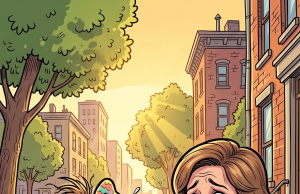
A few blocks away, Maya was leaving a pharmacy, her fingers trembling as she clutched a small paper bag to her chest. At thirty-eight, Maya walked through the city like a ghost in her own life. Since her mother had passed away a year ago, she had become accustomed to breathing around a hollow space in her center. She wasn’t a hero, and she didn’t belong to any animal rescue groups; she was simply a woman who worked, went home, and repeated the cycle in a desperate attempt to sustain her own world.
As she approached the crosswalk, she noticed a strange phenomenon: people were turning their heads for a fleeting second before walking faster. She followed the direction of their gazes and stopped.
The dog was tucked at an odd angle, trying to occupy as little space as possible. Her eyes were tired, carrying a depth of sadness that didn’t come from the cold or hunger, but from the realization that she had been discarded by the only person she had ever known. Maya didn’t move. She stood rooted to the sidewalk while a man nearby muttered that the owner would probably be right back. A woman agreed, and they both vanished into the crowd.
Maya looked around. There was no one holding a leash. No store manager looking out a doorway. Only the dog, the chain, and the roaring avenue.
The Breaking of Indifference
Maya approached slowly, not out of fear, but out of respect for the creature’s dignity. “Hello, sweet girl,” she whispered.
The city continued its relentless thrum, but the dog stared back with an intensity that made Maya’s throat tighten. Bending closer, she saw the red marks beneath the dirty fur—welts where the chain had rubbed for hours, or perhaps days. Maya reached into her bag and pulled out a bottle of water, pouring a few drops into her palm.
The dog hesitated, then leaned forward to lick the moisture. She drank with a strange, hesitant shame, as if she had learned not to demand too much from a world that had already given up on her. As Maya squatted there, the invisible became visible.
A small circle began to form. Now that one person had stopped, the collective amnesia of the crowd began to crack. An older man mentioned he’d seen the dog an hour ago. A baker’s assistant claimed the dog had been there at dawn. A delivery driver confirmed that the animal hadn’t been touched all morning. The pieces of the tragedy were settling into place: this wasn’t a momentary lapse; it was a deliberate abandonment.
The Phantom of the White Sedan
Suddenly, a white sedan braked in the opposite lane. The dog reacted as if an invisible spring had been triggered. She sat bolt upright, her ears tensed and her eyes wide with a fierce, agonizing mixture of hope and terror. She didn’t wag her tail; she simply poured her entire soul into the silhouette of that car.
The light changed, the car moved on, and the dog sank back into herself—slower this time, more broken. Maya felt a physical weight in her chest. The dog wasn’t just waiting for anyone; she was waiting for the person who had left her there.
Maya tried calling the city’s animal services, but was met with the bureaucratic purgatory of recordings and long holds. The sky was bruising with heavy clouds, threatening rain that would turn the sidewalk into a freezing puddle.
Maya looked at her watch. She was going to be late. She thought of excuses, of her boss, and then she looked at the chain. She sent a text: “I found an abandoned dog and I can’t leave her like this.” She took off her scarf and laid it on the pavement. The dog sniffed the fabric and looked back at Maya. The fear was receding, replaced by a weary recognition of kindness. Others began to pitch in—a student bought a bag of food, a man from a nearby cafe brought a bowl. When one person chooses to see, it reminds everyone else that they have eyes too.
The Liberation
The kiosk owner from the corner finally approached with the truth. “I saw a white car stop here before I raised my blinds,” he said. “A man in a dark cap got out. He didn’t say goodbye. He didn’t even pet her. He just tied her up and drove away.”
The cruelty of the physical chain was nothing compared to the cruelty of that discarded love.
The rain began—a fine, cold mist. Maya opened her umbrella, shielding the dog, while a cyclist who had heard the story arrived with a pair of heavy-duty shears. He knelt by the post, and Maya gently held the dog’s neck, whispering for her to be patient.
When the metal finally creaked and the second cut was made, the chain fell to the sidewalk with a dull, heavy thud. There was no cheering. The dog didn’t run. She didn’t even understand. She remained frozen, her body still convinced the metal was holding her.
Maya slowly moved the links aside, revealing the raw skin beneath. Only then did the dog try to stand. Her hind legs, numb from hours of being pinned, gave out, and she fell on her side. The crowd held its breath until she tried again, finally steadying herself on trembling paws. She was smaller and thinner than she had looked when she was curled up.
Maya took off her coat and wrapped it around the dog’s shivering frame. The animal leaned into her, surrendering to the warmth.
But as Maya prepared to lift her, the dog’s head snapped toward the street once more.
A white sedan—the same model as before—stopped at the red light. The dog took a staggered step forward, dragging one numb leg. She released a sound that wasn’t a bark; it was a stifled, fragile moan of pure, agonizing recognition.
Her eyes were no longer on Maya. They were locked onto the glass of that windshield. Two seconds of suspended reality hung in the air. For the dog, the entire world was concentrated in that car. The chain was gone, and the city had finally stopped for her, yet her old loyalty remained as stubborn as the welts on her neck.
Maya followed the dog’s gaze. As the driver slowly began to lower the window, the dog started to tremble—but this time, the cold had nothing to do with it.